Thursday, 1 September 2011
Province and capital
Antakya or Hatay
It seems that certain persons believe that somebody in Turkey want to have the name of Antakya changed to Hatay and this has created some stir in certain waters. What is behind it is this: The Turkish identification cards that show the personal data of the citizen also show the province and the city where the person was born. For at Turk born in Antakya the province would be Hatay and the city Antakya.
This, however, is contradicted by Emre Can Dağlıoğlu who in the newspaper Taraf of August 20, 2011, page 14 has an article with the headline "How Antakya really became Hatay." Dağlıoğlu writes: "In short, the attempt of erasing the name of Antakya is not 'inexperience' as Oltalı would have it. Although the derogative term 'so-called' is used on the practice it is in fact 'a nationalistic administrative measure,' part and parcel of Turkish assimilation policy."
Saturday, 13 August 2011
The Mosque of Habib-i Neccar II
In tourist brochures written about Antakya, the authors take it for granted that the Mosque of Habib-i Neccar was built by Abu Obayda after the city fell to the Muslims in 636 A.D. In one of these brochures called Hatay we read: "The Habib-i Neccar Mosque was built in 636 when the Muslim Arabs conquered Antakya."[i] In another of them we read: "In the year 636 A.D. Antakya was conquered by Abu Obayda Ibn Jerrah, one of the generals of Omar. This was the year when the Habib-i Neccar Mosque was built."[ii] In the book Antiocheia we read on page 237: "The Habib-i Neccar Mosque and the mausoleum was built for the first time by Abu Obayda Ibn Jerrah in the year 638." [iii]
Wednesday, 10 August 2011
Serug
This article was printed in the internet edition of the Turkish newspaper Zaman on August 8, 2001 about an incident that happened 2-300 kilometers northeast of Antakya:
Five dead as adults join children's fight in Turkey's southeast
08 August 2011, Monday / TODAYSZAMAN.COM,
"Five people died and 12 others were injured when a fistfight among a group of children grew larger after their families got involved on Monday in the southeastern province of Şanlıurfa.
Reports said children from the Şahin and Pesen families, which reportedly have a long-standing dispute, in the Suruç district got into a fistfight in the morning. While the fight seemed to have ended, some members of the Pesen family went to the home of the Şahin family and reportedly insulted them.
Following this, members of the Şahin family took out weapons and opened fire on them, killing five people from the Pesen family.
Reports said three of the victims are women. The clash continued for hours and another 12 people were injured. Riot police were sent to the area to end the clash.
Strict security measures were taken at Suruç State Hospital, where the injured individuals were taken, to prevent any further violence. An investigation into the incident has also been launched."
The story is sad but trivial. Incidents like the one described are not unusual along the frontier between Turkey and Syria. What makes the story unusual is that it puts back on the map a city that the world forgot centuries ago: the city of Serug.
In the Bible book of Genesis we read in chapter 11 verses 22 – 26 we read:
"And Serug lived thirty years, and begat Nahor: And Serug lived after he begat Nahor two hundred years, and begat sons and daughters. And Nahor lived nine and twenty years, and begat Terah: And Nahor lived after he begat Terah an hundred and nineteen years, and begat sons and daughters. And Terah lived seventy years, and begat Abram, Nahor, and Haran." (King James Version)
Thus Serug was the great-grandfather of the patriarch Abraham and he had a city called by his name.
This was not unusual. Also Abraham's brother Haran had a city with his name, and also this city still exists at its location about 40 kilometres south of the big city of Urfa (or Şanlıurfa).
The account in the book of Genesis tells us how Abraham's grandson Jacob later settled with his relative Laban in Haran (Harran) where he worked as a shepherd. Eventually he had to run away because of serious differences with Laban about wages. According to Genesis Laban only refrained from doing Jacob harm after divine intervention.
The newspaper story from Suruç (Serug) indicates that not everything in that area has changed since the time of the patriarchs nearly four thousand years ago.
Jacob probably acted wisely by avoiding a confrontation.
Thursday, 4 August 2011
The Mosque of Habib-i Neccar (Habib al-Najjâr)
Nobody seems to know who Habib al-Najjâr was. However, his name has been given to a mosque situated in the central part of Antakya.
Originally this mosque may have been a church and perhaps previously a pagan temple. In ancient times, its location was close to the Cherubim Gate, the western gate of Antioch. Some members of the local churches believe that it originally was the Church of John the Baptist. Whatever the case, in a side chamber to the present mosque there are two sarcophagi, one with the name of the prophet Jonah and one with the name of John the Baptist on it.
It is somehow a riddle what connection the prophet Jonah should have had to Antioch. When it comes to John the Baptist, however, things are easier to explain.
The first place designated as the burial place of the body John was in Sebaste, a small city close to Nablus on the West Bank in Palestine. The saying goes that eventually his bones were taken to Alexandria in Egypt.
It will be remembered, however, that John was decapitated. What became of his head is a lot more obscure. Today the head of John the Baptist is kept in the Topkapı Museum in Istanbul, in the Umayyad Mosque in Damascus, in Church of Saint Sylvester in Capite in Rome, in the Residenz Museum in Munich and a couple of other places, so why not in Antioch? (To readers who would like to know how things like this are possible, I will recommend the book with the title Baudolino by Umberto Eco.)
If we leave the side chamber in the Habib-i Neccar Mosque and descend by the stairway to the crypt under the mosque, things get even more interesting. In a small room there are two sarcophagi, one with the name of Habib-i Neccar (Ottoman for Habib al-Najjâr) and one with the name of Sham’un al-Safa. If we proceed one flight of stairs down to the crypt under this crypt, we find two more sarcophagi with the same names on them. Who are the persons with these names?
Habib-i Neccar
According to Muslim tradition, Habib-i Neccar was the man mentioned in the Qur’an (Sura 36).[i] This man had been sent by God, but was put to death in a certain city (ﻗﺭﻳﺔ). The city is supposed to be Antioch (ancient Antakya). A problem with this interpretation is that the word ﻗﺭﻳﺔ (qarya) according to the dictionary Al-Mawrid has the meaning of “village, small town, hamlet.”[ii] Ancient Antioch can hardly be called a hamlet. It was, in fact, one of the three most important cities in the Roman Empire. Some Muslims claim that the incident described took place in the first century. During the first four centuries of the Christian era, Antioch had about 250.000 inhabitants. It was no “small town.”
Some have tried to identify Habib-i Neccar with the Christian prophet Agabus from the first century. According to “several hagiographic texts,” Agabus suffered martyrdom, but Antioch is not mentioned in this connection.[iii] It should be remembered that there is no mention of any persecution of Christians in Antioch until the one ordered by Trajan in the beginning of the second century.
Sham’un al-Safa
Sham’un al-Safa is even more evasive. The epithet al-Safa (ﺍﻠﺻﺎﻓﻰ) carries the meaning of somebody who is sincere, loyal or devoted,[iv] but the fact that the place of his coffin is regarded by Sunni Muslims as a shrine already indicate that he – by them, at least – is venerated for his devotion and religious loyalty. But who was he?
The name Sham’un is neither Arabic nor Turkish. The word is Hebrew (or Aramaic) and was originally pronounced Shim’on while its Arabic equivalent is Sam’an. This has made some Muslims , especial some with Shiite, Ismaili and Nusayri background, believe that Sham’un al-Safa is Simon Peter, the apostle of Jesus.[v]
This automatically makes us ask two questions: How did the apostle Peter end up in a mosque in the centre of Antakya without the knowledge of the local Christians? And what is he doing in a Sunni mosque when it is Shiite related groups, as the Ismailis and the local Nusayris, who regard him as important? Would you not have expected to find his tomb in one of the shrines (ziyaret) of the Nusayri Alawites?
In answering the first question, it should be kept in mind that there is a very old tradition of Peter visiting Antioch (Antakya). In his letter to the Galatians the apostle Paul describes a controversy he had with the apostle Peter in Antioch (chapter 2 verses 11-13, KJV): "But when Peter was come to Antioch, I withstood him to the face, because he was to be blamed. For before that certain came from James, he did eat with the Gentiles: but when they were come, he withdrew and separated himself, fearing them which were of the circumcision. And the other Jews dissembled likewise with him; insomuch that Barnabas also was carried away with their dissimulation."
However, Peter did not stay in Antioch. According to the Bible, he later on wrote a letter from "Babylon" which may refer to Babylon in Mesopotamia or Babylon in Egypt.[vi] According to Catholic tradition, he died in Rome and was buried there.[vii] To our knowledge there is no tradition that places the tomb of the apostle Peter in Antioch.
So what is the coffin of Sham’un al-Safa doing in the crypt of a Sunni mosque? We do not know. Whoever he may have been, his name indicates that he was not a Muslim.
When you read Turkish books about Antakya (as for example Uysal Yenipınar, Antiocheia (İzmir: Etki Yayınları, 2010), you get the impression that the Habib-i Neccar Mosque was first built in 638 by Abu Ubayda Ibn Jarrâh who had conquered the city from the Byzantines. It is not likely, however, that Abu Ubayda chose an empty spot for his project. The usual procedure in antiquity was that Christians converted pagan shrines into churches and the Muslim later turned these into mosques. The spot where the mosque is located was within the walls of the original Seleucid city and close to the centre of the Byzantine city taken by Abu Ubayda. There was hardly any empty plot of land there.
Thıs leads us to believe that the mosque was originally a church, and perhaps the local Christians are right when the claim that it was the Church of John the Baptist. That would also explain why a sarcophagus with his name on is kept there. If this is the case, we may also draw the conclusion that some ancient Christian saint is hiding behind the name of Sham’un al-Safa.
Sham’un was very likely a common name among the Aramaic speaking Antiochenes. We know at least two local stylites with that name. The first is Symeon the Stylite the Older, who eventually moved up to the plateau between Antioch and Aleppo where he sat on his pillar until his death. He was buried in Antioch.[viii] The second is Symeon the Stylite the Younger who had grown up in the quarter just beside the church that was later on turned into the Mosque of Habib-i Neccar.[ix] This Symeon was not buried in Antioch, but besides his pillar on the "Miraculous Mountain" at Samandağ. What happened to his bones later on, nobody knows. [x]
[i] Marmaduke Pickthall, trans. The Glorious Qur’an (Istanbul: Çağrı Yayınları, 1999), 440 – 442.
[ii] Rohi Baalbaki, Al-Mawrid (Beirut: Dar al-Ilm lilmalayin, 2005) 858.
[iii] G. Vajda, “Habib al-Nadjdjâr,” The Encyclopaedia of Islam, Vol. 3 (London: Luzac & Co., 1986), 12.
[iv] Baalbaki, Al-Mawrid, 686.
[v] "The Ismailis view history as a progressive cycle, which advances through seven major cycles, each inaugurated by a natiq (speaking prophet; pl. nutaqa’) or ulu’l-‘azm (endowed with resolution) who brings revelation and promulgates law in its external form. Adam, (Adam), Nuh (Noah), Ibrahim (Abraham), Musa (Moses), ‘Isa (Jesus), and Muhammad were the six nutaqa’. Each succeeding natiq abrogates the law of his predecessor and brings a new law. Natiq is followed by asas (foundation), or samit (one who remains silent) who promulgates the batin through ta’wil, Shith (Seth), Sam (Shem), Isma‘il (Ishmail) or Ishaq (Isaac), Harun (Aaron), Yusha‘ (Joshua) the son of Nun, Sham‘un al-Safa (Simon Peter), and ‘Ali were the six usus of the aforementioned six nutaqa’." – Ismail K. Poonawala, "Ismaili Literature in Persian and Arabic" (The Institute of Ismaili Studies, 2008), 4, 5, accessed August 4, 2011, http://www.iis.ac.uk/WebAssets/Medium/News/Ismaili%20Literature%20in%20Persian%20and%20Arabic.pdf. See also http://www.ismaili.co.uk/cyclical-time-and-sacred-history-in-medieval-ismaili-thought.shtml and http://www.shiastudies.com/library/english/00-noor/wig/018-Stories_of_Prophets/isa2.htm, accessed August 3, 2011. Henry Corbin, Cyclical Time and Ismaili Gnosis (London: Kegan Paul International, (no date)), 96, accessed August 3, 2011, http://www.amiscorbin.com/textes/anglais/Corbin%20Cyclical%20Time.pdf
[vi] Wikipedia, "Babylon Fortress," accessed August 4, 2011, http://en.wikipedia.org/wiki/Babylon_Fortress.
[vii] New Advent, "St. Peter, prince of the Apostles," accessed August 4, 2011, http://www.newadvent.org/cathen/11744a.htm#IV
[viii] Glanville Downey, A History of Antioch in Syria from Seleucus to the Arab Conquest (Princeton: Princeton University Press, 1961), 481.
[ix] Ibid., 553-555.
[x] M. Grazia Zambon, Domenico Bertogli & Oriano Granella, Antioch on the Orontes … where the disciples were first called Christians … (Parma: Edizioni Eteria (no date)), 97.
Monday, 1 August 2011
Back in town
Especially our trip to Damascus was interesting. The bus company had informed us that they were going from Antakya to Damascus and back every day and they had not met with any problems. Friends in Syria informed us that they went to work and back every day without any unpleasant experiences. If we should believe the press all Syria would look like the front in Libya. On the other hand, if you were to believe that what is shown on Turkish television is a true reflection of what is going on here in this country, you would never leave your home.
On the way to Damascus nothing happened. We saw some tanks parked somewhere, but that is not unusual. In Damascus everything was as usual. The only difference to notice was the very limited number of tourists in the streets.
On the way back in bus from Damascus to Aleppo, we met a big group of people on motorcycles demonstrating for or against something or somebody. Some of them carried a picture of a man. It was not clear if it was the president or somebody else.
Fortunately, Antakya is more predictable. Some may call it a dull city, but it is a good place to work.
Thursday, 21 April 2011
Easter
Tuesday, 29 March 2011
Homoousios
This viewpoint was already spreading in the first century. In verse 7 in his second letter the Apostle John wrote: “Because a number of false teachers have gone out into the world, who do not give witness that Jesus Christ came in the flesh. Such a one is a false teacher and Antichrist.” It is believed that John wrote this letter from Ephesus (Efes) at the Aegean coast several hundred kilometres from Antioch, but the doctrine also found supporters here.
While John was living in Ephesus Ignatius was the overseer (or bishop) of the congregation in Antioch. In a letter to the congregation in Smyrna (İzmir) he wrote (chapter 5): “For what does any one profit me, if he commends me, but blasphemes my Lord, not confessing that He was [truly] possessed of a body? But he who does not acknowledge this, has in fact altogether denied Him, being enveloped in death. I have not, however, thought good to write the names of such persons, inasmuch as they are unbelievers. Yea, far be it from me to make any mention of them, until they repent and return to [a true belief in] Christ’s passion, which is our resurrection.”
The problem had its roots in Gnostics thinking. The syncretistic world scheme of the Gnostics had it that everything material was by nature bad. Consequently the body of Jesus could not have been material.
This idea seems to have been very popular in and around Antioch. Nearly a hundred years after Irenaeus a letter claimed to have been written by the Apostle Peter was in circulation. As this letter contained “modern” doctrines based on Gnostic ideas, a bishop named Serapion (d. 211) wrote a letter to the small town of Rhossus (Arsuz) at the Mediterranean coast on the other side of the Amanus Mountains:
“We, brethren, receive Peter and the other Apostles even as Christ; but the writings that go falsely by their names we, in our experience, reject, knowing that such things as these we never received. When I was with you I supposed you all to be attached to the right faith; and so without going through the gospel put forward under Peter's name, I said, `If this is all that makes your petty quarrel, why then let it be read.' But now that I have learned from information given me that their mind was lurking in some hole of heresy, I will make a point of coming to you again: so, brethren, expect me speedily. Knowing then, brethren, of what kind of heresy was Marcion ... From others who used this very gospel— I mean from the successors of those who started it, whom we call Docetae, for most of its ideas are of their school— from them, I say, I borrowed it, and was able to go through it, and to find that most of it belonged to the right teaching of the Saviour, but some things were additions.”
In Antioch, however, there were people who fell into the opposite ditch. They believed that the divine Logos (λογος: word) mentioned in the Gospel of John (1:1) was a quality of God, His Reason indwelling or Reason expressed. They claimed that Jesus by birth was no different from others but that this Divine Reason, nearly as an emanation from God, had been dwelling in Jesus since his baptism by John.
In connection with the relationship between God and his Word (λογος) a later bishop of Antioch named Paul of Samosata (d. 275) was teaching that they were consubstantial (͑ομοουσιοι: homoousioi).
This word might have the denotation “of the same substance,” but it could also mean “of the same being.” And besides, it had unpleasant connotations.
Words do not have denotations only. They also have connotations, for example the thoughts they create in your mind because of their history. Until the first half of the 20th century the word Führer was a neutral German word. But after the Second World War it has taken unpleasant connotations.
The same was the case with the word homoousious. Although it may have been used by certain Christian philosophers it was mainly popular among the Gnostics, groups of people who had built up religious systems on a mixture of paganism, theosophy, Greek philosophy and Christianity. And they were not at all popular with the mainstream Christians.
Pier Franco Beatrice has the following comments on the early use of the word:
“Basilides, the first known Gnostic thinker to use homoousios in the first half of the second century, speaks of a threefold sonship consubstantial with the god who is not. The Valentinian Gnostic Ptolemy claims in his letter to Flora that it is the nature of the good God to beget and bring forth only beings similar to, and consubstantial with himself... So homoousios was certainly in current use by the second-century Gnostics, and through their works it became known to the orthodox heresiologists. Nevertheless, it must be stressed that in Gnostic texts homoousios has no reference to the specific relationship between Father and Son, as is the case in the Nicene Creed.”
That the word homoousios took on different shades of meaning dependent on the ones who used it did not matter. The word was foreign to Christianity and by its connotations it would easily give some people ideas about the relationship between God and Jesus that were foreign to subordinationist Christians.
Consequently, when Paul of Samosata started to use the homoousion on God and Logos the Church reacted strongly. A council was held in Antioch where the attending bishops had Paul deposed and excommunicated.
But this was not the end of it. In 325 at the Council of Nicaea (İznik, Turkey) the Byzantine Emperor Constantine the Great in his attempt to unify his empire suggested that the Church should agree that the Father and the Son were homoousioi, of the same substance.
This was an embarrassing situation. The term with its Gnostic connotations had been anathematized by a council of bishops in Antioch only 57 years earlier, and now the unbaptised Emperor wanted it reintroduced!
The bishops, or most of them, accepted. After all, it was Constantine that had had brought an end to the persecution of the Church. And furthermore, although still a pagan he regarded himself as a sort of bishop for both Christians and idolaters.
Notes.
- Philip Schaff, ed. The Apostolic Fathers with Justin Martyr and Irenaeus, (Christian Classics Ethereal Library, 2002), 144.
- Wikipedia, Serapion of Antioch, accessed March 27, 2011, http://en.wikipedia.org/wiki/Serapion_of_Antioch
- Pier Franco Beatrice, “The Word "Homoousios" from Hellenism to Christianity Author(s)” Church History, Vol. 71, No. 2 (Jun., 2002), (Cambridge: Cambridge University Press on behalf of the American Society of Church History), 243-272.
- A. H. M. Jones, Constantine and the Conversion of Europe, (Harmonsworth: Penguin Books, 1972), 155–159.
- D.S. Wallace–Hadrill, Christian Antioch: A study of early Christian thought in the East, (Cambridge: Cambridge University Press, 1982) 7.
Thursday, 3 March 2011
Blocking a blog
I started to wonder what I had written that might offend Turkish authorities. Then I found out that it was not my blog only but the entire blogspot.com that had been blocked in Turkey. The reason seems to be that somebody has used the site for illegal purposes. In Turkey this was a front page story yesterday. One of the papers sarcastically wrote: Why not close down all the internet to be on the safe side!
Unfortunately it is not unusual in this part of the world to "apply iodine to all the body" - even if this procedure includes doing injustice to innocent people. The only thing you can do is to wait patiently until the problem is solved - in case you cannot find other ways to evade the obstruction.
Saturday, 4 December 2010
The buffoons of Antioch
"Besides the Greek population, indeed, which was nowhere in the East (with the exception of Alexandria) so numerous as here, Antioch numbered among its population a considerable number of native Syrians, speaking Syriac. These natives composed a low class, inhabiting the suburbs of the great city and the populous villages which formed a vast suburb all around it— Charandama, Ghisira, Gandigura, and Apate (chiefly Syriac names). Marriages between the Syrians and the Greeks were common. Seleucus having formerly made naturalization a legal obligation binding on every stranger establishing himself in the city, Antioch, at the end of three centuries and a half of its existence, became one of the places in the world where race was most intermingled with race. The degradation of the people was terrible. … It was an inconceivable medley of merry-andrews, quacks, buffons, magicians, miracle-mongers, sorcerers, priests, impostors; a city of races, games, dances processions, fêtes, debauches, of unbridled luxury, of all the follies of the East, of the most unhealthy superstitions, and of the fanaticism of the orgy.” (Ernest Renan, The Apostles, (New York 1867), 198 199.)
People in modern Antakya are not like the old Antiochenes, but there are certain similarities.
"Unhealthy superstition" can be found, and so can 'merry-andrews, quacks and buffoons.'
A couple of days ago we were sitting in the workshop of one of our friends. The place has the size of a big dining table. He was busy behind his workbench and his assistant, who was sitting there as well, was doing nothing. Our friend is originally an Orthodox, but he is also involved with the Catholic Church. His assistant is a Protestant whose discourse has been indirectly influenced by people in the Bible Belt.
While we were sitting there a man rushed in with a deranged expression in his eyes and a gun in his hand yelling and screaming: "I'll kill you, I'll kill you." He was mainly pointing his gun at the Protestant, but in between - so as to make a point - he was aiming at the rest of us as well. We are not young and we have met crazy people before, so we relaxed and pretended that everything was normal.
This evidently made him feel that we did not take him seriously enough. Consequently he produced a bullet from somewhere, loaded the gun and repeated the séance. Suddenly he rushed out of the room just to return brandishing his pistol while pouring out torrents of threats. But when he saw that we were unimpressed, he put the gun on the workbench and said: "All stand! We are going to pray."
The two of us and our friend did not move. The Protestant rose. We did not find out whether he rose because he was under the influence of the show with firearms he had just witnessed or it was due to his peculiar type of religiosity. But he rose while we and our friend kept sitting.
This annoyed the perpetrator and he started to insist although he did not resort to armed persuasion. Finally he gave up. Instead he started his prayer while he and the Protestant were standing with their hands opened heavenward.
Until this point the two of us had no idea about the religious persuasion of our new acquaintance. It turned out that he belonged to the Orthodox faith. First he was rattling off a prayer in Turkish, next in Arabic all the time making the sign of the cross the Orthodox way.
After having shot his bolt - if this expression is admissible in this context - he sat down taking the place of the Protestant who kept standing as there was nowhere else to sit. Subsequently we had a fairly civilised conversation. All the rest was supposed to be a joke - perhaps apart from the prayer.
In the Western World opinionated Europeans and Americans believe that when someone from the Middle East behaves irrationally he has to be a Muslim. Our experience proves this assumption wrong.
Friday, 26 November 2010
Aleppo and Damascus seen from Antakya
Antakya has regained some of its importance under the Turkish Republic, but a visit to the three cities clearly shows the visitor that Antakya is far behind her two sisters. Antakya is a small town of 200.000 souls while both Aleppo and Damascus are metropolises with millions of inhabitants.
It is easy for people of Antakya to visit Syria. They do not even need a visa to cross over into Syria. But if you are not a Turk or an Arab things are more complicated. The Turkish side is easy, but at the Syrian side the undaunted traveller is met with a curious combination of Ottoman bureaucracy and French legalism of the former century. Forms have to be filled and stamped and all details about the traveller are registered on old computers by policemen holding the passport of the guest in his one hand while pecking the keyboard with one single finger of his other hand. You feel lucky when you manage to get through.
Syria has also introduced another oddity: You have to pay to get out of the country. You have already paid for your visa, but when you leave the country you have to pay something like 10-15 dollars to get safely back to Turkey. It is fine to go by bus when going to Syria, but on the way back buses may stay for hours in customs while private cars and taxis get through easily. And taxis from (and to) Aleppo are cheap. You pay about ten dollars per person for one way.
Aleppo and Damascus have many things in common with Antakya. Architecture of the old Syrian houses are similar although these houses in Aleppo and Damascus are bigger and more well-preserved that those of Antakya. It even applies to the simple unpretentious houses in the old part of town. In Damascus the inhabitants of the old quarters see to it that their houses do not fall apart. In Antakya the owners simply leave the house and let it fall into disrepair, perhaps hoping that it will topple over so that a concrete monstrosity can be built instead.
As also seen in Antakya some of the old buildings are used as restaurants. They are built in several storeys with a big yard in the middle. The restaurants usual have a removable “roof” of plastic or canvas over the courtyard so that guests are not harassed by dew or rain.
The religious tolerance so peculiar to Antakya is also seen in Aleppo and Damascus. In Damascus there are many Christians. You see churches and hear church bells blending with the Muslim call to prayer. Aleppo has many Nusayri Alewites, Armenian Christians, Catholics and members of the Orthodox and Syrian Churches together with the majority of Sunni Muslims. You see women completely covered in black and women in clothes so tight that you believe that it is sprayed on. Although the Muslims are in majority no attempt is made to change the dress code of others or to prevent the ringing of church bells. One may wonder where some countries in Western and Eastern Europe have dug up their bigotry.
In Aleppo the old Hotel Baron still exists. It has had so famous guests as Lawrence of Arabia, Agatha Christie (she wrote The Murder on the Orient Express there), Gertrude Bell and even the “father” of the Turkish Republic Mustafa Kemal Atatürk. And by the way, King Faisal declared the independence of Syria from one of the balconies – presumably the one from where some of the guests were shooting ducks at another occasion. At that time the hotel was outside the city. This has changed. The noise of traffic is as unbearable as it is in all other big cities of the Middle East.
Besides the two Syrian mega-cities Antakya in Turkey is a very small place – less interesting, but a lot more relaxing to live in.
Saturday, 13 November 2010
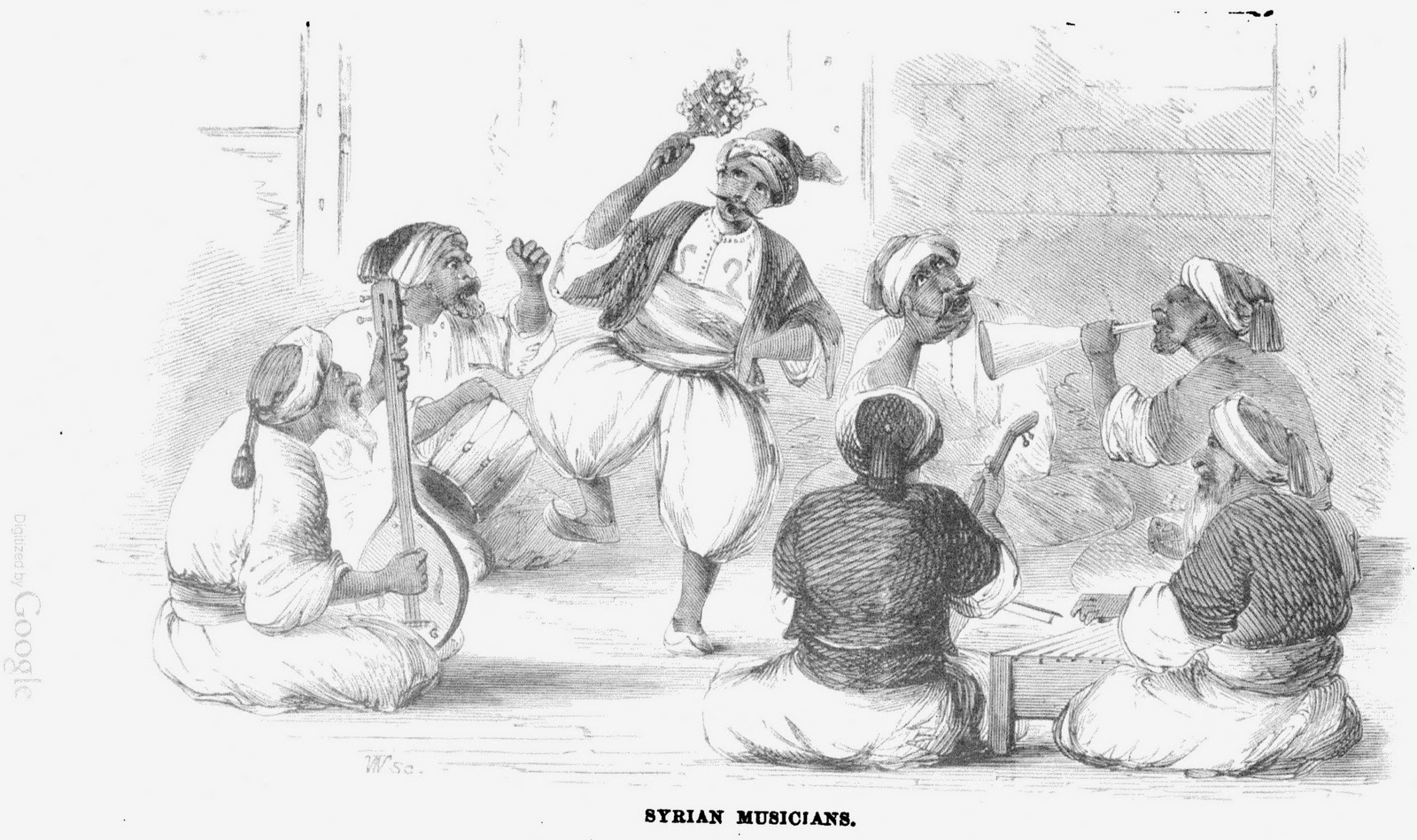
Music
But the Antiochenes' love of music did not die with Chrysostom. When the Crusaders arrived they no doubt started to like the local rhythms and cadences when they got used to them. Some of the musicians they had had along and some of those who visited the Crusader Principality of Antioch together with "the Queen of the Troubadours" Catherina of Aquitaine could use the Eastern sound in their music. Much of French music of the thirteenth century has a Middle Eastern ring. It naturally has to be admitted that the Arabic influence from Spain was strong as well.
Music was also popular in Antakya when F. A. Neale stayed here for seven months in 1847. At that time it was a small Jewish band who was in charge of the entertainment.
They may have been appreciated by the locals, but so not much by the handful of Europeans who were living in Antakya at the time of Neale's stay. At that time an Italian priest and an Italian physician were living in Antakya. Neale relates: "The priest is a musician, and consequently detests Arabic songs, &c., and styles those present a set of 'brutti buffoni.' The doctor, on the other hand, was never guilty of whistling a single bar of any music correctly; and, being moreover a bit of a sycophant, he presents to be enchanted with what is going on, and actually has the audacity to try and beat time with his foot."(2)
Neale may not be completely fair in his assessment. It seems that he himself did not appreciate the efforts of the Jewish band. Arabic - and Turkish - music may be an annoying experience for those who do not try to understand what they hear. But if you give it a chance it is extremely fascinating.
Today there is no Jewish band, but the same sort of music is played at some of the restaurants in Antakya. The restaurant Mado besides the old parliament building has had a very good band playing classical Turkish fasıl music.(3)
PS: I forgot to mention that the priest in Neale's story was killed a couple years later. Two workers from a local soap factory appeared at his home, slit his throat and put him on the altar of the chapel with a carpet or blanket over. The instigator was fined and sent to Iraq. The priest was buried on a plot of land in front of what is called the Grotto of St. Peter.
______________
1. John Chrysostom, (NPNF1-09) St. Chrysostom: On the Priesthood; Ascetic Treatises; Select Homilies and Letters; Homilies on the Statutes (URL: http://www.ccel.org/ccel/schaff/npnf109.html) Author(s): Schaff, Philip (1819-1893), Publisher: Grand Rapids, MI: Christian Classics Ethereal Library, p. 234.
2. Neal, F.A., Evenings at Antioch, London 1854, p. 31
3. A popular variation of Türk Sanat Müziği [Turkish Art Music] mostly played in Istanbul tavernas.
Monday, 18 October 2010
Garbage
One of the locals told us that some years ago the torrent Parmenius where the Iron Gate serves as a dam or barrage swept the contents of an upstream refuse dump along. You may well say that this refuse dumb settled down in front of the Iron Gate.
This explanation is quite acceptable, but one still wonders why nobody has taken the initiative to have all this junk removed. After all, the Iron Gate is one of the places foreign tourists may visit, and what they see will leave them with a strange impression of Antakya.
The attitude towards junk and garbage may be an old one. In Ottoman times the State was not regarded as a juristic person. Any place not owned by anybody was a potential waste dump. This is not how things are today, but people have had their eyes trained so that they do not see the rubbish around them.
The Iron Gate is not the only example. A few hundred metres south of the torrent Phyrminus (or Akakir) there is another gorge between two crags. When it is raining a torrent comes down through this gorge. An old bridge is connecting the two sides. (This bridge may have been on the road between Daphne and the St. George Gate.) Also the site of this bridge is used as a garbage dump. Even tractors with trailers unload their junk their – as if historical places and garbage dumps were one and the same thing.
The problem may start in school. The teacher may be effective in teaching children to pass exams, but not to take care of nature or their historical inheritance. The two pictures below illustrate what a beautiful green area looks like after the visit of a group of boys fresh from school.
Saturday, 9 October 2010
The Iron Gate
It is said that the Iron Gate was built by Justinian, but he may just have improved it. It is situated at the gorge between Mount Cassius and Mount Staurin. Procopius, a Byzantine scholar from the sixth century, gives us the following description:
“It is proper to describe also what he did with the torrent which comes down from these mountains. Two precipitous mountains rise above the city, approaching each other quite closely. Of these they call the one Orocassias [Mount Cassius] and the other is called Staurin. Where they come to an end they are joined by a glen and ravine which lies between them, which produces a torrent, when it rains, called Onopnictes.[1] This, coming down from a height, swept over the circuit-wall and on occasion rose to a great volume, spreading into the streets of the city and doing ruinous damage to those who lived in that district. But even for this the Emperor Justinian found the remedy, in the following way: Before that part of the circuit-wall which happens to lie nearest to the ravine out of which the torrent was borne against the fortifications, he built an immense wall or dam, which reached roughly from the hollow bed of the ravine to each of the two mountains, so that the stream should no longer be able to sweep on when it was at full flood, but should collect for a considerable distance back and form a lake there. And by constructing sluice-gates in this wall he contrived that the torrent, flowing through these, should lose its force gradually, checked by this artificial barrier, and no longer violently assault the circuit-wall with its full stream, and so overflow it and damage the city, but should gently and evenly glide on in the manner I have described and, with this means of outflow, should proceed through the channel wherever the inhabitants of former times would have wished to conduct it if it had been so manageable.” [2]
The Iron Wall – or what is left of it – is still to be seen up behind Mount Staurin where the spurious Church of St. Peter is located. This grotto attracts a lot more attention that the real thing some hundred metres behind it. You hardly meet any tourist if you visit the Iron Gate.
Mankind is more interested in fakes than facts.

[1] “Donkey-Drowner”, the nickname of the torrent Parmenius. During the winter this torrent swelled as it came rushing down between the two mountains and swept away anything in front of it.
[2] Procopius, Buildings – Book 2, Ch. 10:15-18. Evidently there already was some device for that purpose at the place. But most of the masonry is from the time of Justinian. – Glanville Downey: A History of Antioch in Syria, Princeton 1961, p. 551
Monday, 30 August 2010
Philosophy
In his book Christian Antioch – A Study of Early Christian Thought in the East (Cambridge University Press 1982) D . S. Wallace-Hadrill explains how the Christians during the first couple of centuries after the death of the apostles of Christ came under the influence of pagan Greek philosophy.
Some of the Christians in the second century were philosophers before their conversion, others were people who followed the intellectual fashion of the day or apologists who believed they could convert the pagans by using their discourse.
Interestingly the approach of the Christian writers of Antioch was very pragmatic and objective. They interpreted the Bible according to the grammar of the text and what they knew about the historical background of the narrative. If one should pick a Greek philosopher whose method was closest to that of the Antiochenes, it would be Aristotle. But there was hardly any direct connection. The interest in the works of Aristotle in the Eastern Church started long time after Antioch lost its theological importance.
The philosophical discourse at that time was strongly influenced by the idealism of Plato. It was a sort of paradigm that made people accept unstated assertions without being aware it. As Wallace-Hadrill writes (page 97): “In the cultural millieu that was predominantly Platonist, a Christian could of course be open to Platonist influence without being aware of it, and it could find a place in his unexpressed assumptions.”
One may for example wonder how Christians – especially in Antioch – started to believe in the immortality of the human soul. In the Hebrew Bible, that was regarded as an authority by Antiochenes as the bishop Theophilus, the word נפשׁ (nefesh) translated psyche (ψυχη: soul) in Greek meant the material living person. This is also how the word is used in the New Testament (as in Pauls first letter to the Corinthians chapter 15 where he contrasts the psychical with the spiritual using ‘psychical’ synonymous with ‘material’).
Wallace-Hadrill continues (pages 99 & 100): “The fragments that remain of the proceedings at the trial of of Paul of Samosata in 268 [in Antioch] are sufficient to show that the Antiochene judges maintained a generally Platonist view of the relation of soul to body. The ontological separation of soul and body is expressed in fragment 16, in which man is described as being composed of flesh and of ‘somebody’ within – the ‘interior man’ of fragment 30. The soul-complex is the real person in a fleshly covering.”
This totally Platonist understanding of the nature of man would have surprised both the writers of the Old Testament and the Christians of the first century. But it illustrates how easily we are influenced by the ideological air we breathe.
Today the ideological paradigm of the Western World is not Platonism but rather humanism and individualism. And often people who call themselves Christians advance humanistic ideas honestly believing that they represent New Testament teachings.
Here in Antakya the same thing is observed among modern people calling themselves Muslims. They try to explain, justify and even rationalise their beliefs by means of western philosophy and science.
The important thing is that your ideas are in fashion
Sunday, 22 August 2010
Abduction
As mentioned in the blog of my friend Christopher Ecclestone entitled The Dig at the Daphne Bridge (May 22, 2010) the old Daphne Bridge over the torrent Phyrminus in Antakya has been unearthed in connection with canalisation repair. At that site last night I had an interesting experience that reveals how the human mind works.
We were on our way home after an Arabic coffee (served in Turkish tea glasses and called suvari) at the nearly historical coffee house Affân. When we passed the place of the old bridge one of our friends asked me: “They say that this is a tunnel used by smugglers that takes you to the other side of the Syrian border. Is that true?“
It should be mentioned that the distance to the Syrian border is about 50 kilometres. There are mountains part of the way. Those who within the last couple of months invented the myth of a smuggler tunnel never bothered to explain to themselves how it would be possible secretly to make a tunnel all the way to Syria when the government spends millions of lira to have a tunnel made through 5 kilometres of mountain other places in this country.
This brings us to how our mind works. When we know everything about a matter we are able to draw conclusions about singular aspects of this matter with the same certainty as you have about the whole. Example: 1. All humans are mortal. 2. The president is a human. > The president is mortal. This is called deductive reasoning.
Most often we do not know all the details about a certain question, but we know sufficient to have an opinion. 1. Some banks do crack. 2. This bank has never had any financial problem and as far as I can tell it is economically sound. > It is unlikely to crack. I can safely deposit my money there. This is called inductive reasoning. As we are not omniscient this is the reasoning we base most of our informed decisions on. It is also our basis for scientific theories and for religious faith - if we happen to base our faith on reason at all.
The third “discipline” is abductive reasoning* described by the logician Charles Sander Pierce as guessing. You could call it jumping to conclusions. In your daily life you are suddenly faced with something new and surprising, something for which you have no rational explanation. You do not have any premises to base your deduction or induction on. So you simply try to find an explanation on the basis of what the new experience looks like in comparison with what you have seen or heard before.
When you take a look at the old bridge across the Phyrminus as shown on the picture in the blog cited above it looks like the entrance to a tunnel because you do not see the other side of the bridge. In fact, had it been a tunnel its direction would lead you away from Syria, but the myth-makers did not think of that. On the other hand: Who are using tunnels? Smugglers are. Where do smugglers from this neighbourhood go? They go to Syria. So this must be a smuggler tunnel to Syria although it is leading you in the wrong direction.
We are such stuff as myths are made of.
_________________
* Abduction