Sunday, 8 August 2010

Violence

.

We are told that the inhabitants of Antioch used to be a irresponsible lot. They loved entertainment and did not take rules and standards too seriously. This resulted in a superficial tolerance between the various groups and denominations of the city. Whenever other issues such as economy, politics or even the teams on the race ground got involved, the shallow tolerance towards those different from your own group was easily replaced by violence.

People of modern Antakya are generally speaking as tolerant as those who were living here a couple of thousand years ago. And fortunately we do not have the riots that haunted the city in Byzantine times. People here are mostly easygoing and tolerant. The tendency of sudden outbursts of violence however can still be seen – but for other reasons than those of old.

Yesterday we met a young, pretty girl of nineteen yeas old. Across her forehead she had a big wound stitched together with eight stitches. When we asked her what had happened she told us that she had been battered by her big brother. He had wanted her sunglasses and she would not give them to him. The result was anger and violence so serious that had the assault happened in another city or country the doctor who dressed the wound would have notified the police immediately.

One may wonder what the psychological mechanisms behind this aggressive behaviour may be. There are several explanations. One of them is a belief, also shared by many individuals outside Antakya, that problems can be solved by violence. An observer from another culture may find it strange that anybody can have this approach, especially in a country still suffering under blood feuds. Violence breeds hate and hate breeds violence. Violence does not create respect, but disgust and the perpetrator appears pathetic.

Another phenomenon that should not be overlooked is the way many locals spoil their sons. It may be a hangover from times when the society here believed in feudalistic virtues: It was a shame society, not a guilt society. What mattered was not what you did, but your ability to defend you “honour”. The ideal was the “macho”, the male chauvinist.

When people in the West speak of male domination and the suppression of women in the Middle East they usually focus their indignation on the father, the head of the family. They forget that it is mostly not the father who raises his sons. He is at work during the day (here in Antakya he may even be working in Saudi Arabia or the Gulf States only showing up once a year), and if he does not go to the coffeehouse in the evening or is out eating with his friends, he at least does not spend his evening on teaching ethics to his children. This is the mother’s job.

And the mother very often spoils her sons. This gives way to a mother fixation that is nearly unknown in the West. Sometimes she even gives her son the idea that he is Mister Marvellous, and at any rate better, handsomer and more intelligent than his sisters. Unfortunately they sometimes believe in this hoax as well. And when they don’t, he tries to defend his “honour” by resorting to violence.

If you want to find a culprit, look for his mother.

_______

Friday, 30 July 2010

The visit of Jean de la Roque

.

After the conquest of Syria and Egypt by the Ottomans early in the sixteenth century the Pax Ottomania facilitated visits by Europeans. In 1629 a French priest named Philippe paid Antakya a visit. He was followed in 1667 by a certain von Troilo, Knight of the Holy Sepulchre, and in 1688 came the French journalist and orientalist Jean de la Roque.

In his book Voyage de Syrie et du Mont-Liban (Amsterdam 1723) De la Roque gives a very thorough description of Antakya as he saw it towards the end of the seventeenth century.

His first impression was ‘as if the city was located in a big forest, or as if it was a forest in a city’. Within the walls there were “plane trees, poplars, elm trees,[1] sycamore trees & other big trees”.[2]

After this De la Roque mentions the names that were used on Antioch by ancient writes: The capital of the Orient, The capital of Syria, The Great, and also The Perle, The Eye or the Head of the Orient. But he adds: “This former grandeur only serves to astonish and sadden the curious traveller who is somehow conversant and able to compare ancient Antioch with the city that bears her name today.”[3]

De la Roque goes on to describe the walls (“ten thousand paces long”). Inside the walls “one hardly sees anything but ruins and desolation.” De la Roque then describes the citadel on top of Mount Cassius which he believed was the “Palace of Seleucus”. He also reports having seen a temple and columns with Corinthian capitals up there.

Interestingly De la Roque claims that the ruins of the Cathedral of St. Peter were still to be seen at his visit: “The Christians of Antioch still see with pain what is left of the famous basilica now collapsed that had been dedicated to the Prince of the Apostles by the Emperor Constantine and described so beautifully by Eusebius. It was in this house of worship it is believed that they found the tip of the spear that pierced the side of the Saviour.”[4] Close to this ruin De la Roque claims to have seen the ruins of the temple of Tyche (Fortune) that was later turned into a church for the martyr bishop Ignatius.[5] He does not metion the so-called Grotto of St. Peter.

De la Roque refers to an imperial edict issued about a hundred years before his arrival. According to this the government in Istanbul decreed that the citadel of Antakya should be repaired and that more houses were built in the city. “This would attract more inhabitants, Turks, Greeks, Armenians & Jews without whom this city today would have been nothing but a waste.”[6]

After the year 1306 the governor of Damascus under the Mamluk dynasty let about 300 Turcoman families settle along the Mediterranean coast between Beirut and Antakya. so from the start of the fourteenth century the population of Antakya had to a very large extent been consisting of Turcoman tribesmen with their herds and flocks.

If the claim of De la Roque is correct the homogeneity of the city had already started to change before his arrival as the forefathers of the present Jewish and Christian population of Antakya had settled there. A census taken 22 years after the visit of De la Roque counted a male population of 3.493 with 1.161 tradesmen.[7] The majority of these tradesmen no doubt were to be found among the newcomers.


[1] The French word is lotus

[2] Unfortunately one has to admit that this is not what Antakya looks like today.

[3] De la Roque, p. 201

[4] ibid. p. 203

[5] ibid. p. 204

[6] ibid, p. 205

[7] http://www.akademiantakya.org/eng/3.htm

Tuesday, 27 July 2010

The School of Antioch

From very early times there had been a difference of approach between the theologians of Alexandria in Egypt and that of those in Antioch. From the beginning Alexandria had represented a mixture of Egyptian and Hellenistic thinking. Allegoric interpretation of religious writings was popular. Thus the Jewish philosophers as Philo of Alexandria (d. A.D. 50) applied allegoric interpretations on the Hebrew Bible. On this background the theologians Clement (d. c. 215) and Origen who were living at the end of the second century and in the beginning of the third explained the Bible allegorically as had already been done on Homer’s poems by Greek philosophers. This does not mean that Origen denied that there was history behind the Biblical text. But this was not important to him – especially where he could not harmonise the text with what he felt was difficult to explain historically.[1]

In 232 Origen had to leave Alexandria and he settled in Caesarea in Cappadocia (modern Kayseri in Turkey) where he continued his exegetic theology along his Alexandrian line. His ideas about Jesus are said to have influenced Lucian of Antioch and the church historian Eusebius of Caesarea.

Also the idea called Monophysitism, the teaching that Christ has only one nature in which the human aspect has been absorbed by the divine, was a result of the Alexandrian way of thinking. It has been said that this theology virtually negated the humanity of Christ. The Egyptian mythology with Pharaoh as a divine being, the materialisation of the god Horus, may have had some influence on this claim.

The School of Antioch had a different approach. Here theology was based on grammatical and historical interpretation of the Biblical text. It was admitted that certain parts of the Bible should not be understood literal; still the exegesis should be dependent on the historical background of the text. Some of these theologians had knowledge of both Hebrew and Greek and were able to understand the history behind the Greek terms used in the Greek translation of the Old Testament and in the New Testament as well. One might say that their approach was rational and scholarly.

Historically the School of Antioch had three phases:

  • The early period starting about 270 with Lucian of Antioch.[2]
  • The middle period from about 350 to 433 with Antiochian theologians as Diodore of Tarsus (d. c. 390), Theodore of Mopsuestia (d. c. 428) and John Chrysostom.
  • The late period after 433.

The characteristics of the School of Antioch were as follows:

The approach to exegesis as applied by the theologians of Antioch was strictly historical. Allegory was only used occasionally and it was held that the biblical text was written in a way that was understood by people with a certain historical background. The events described in the text were real events. One might say that this way of interpretation was close to that of the Jews.[3]

Although not interpreted allegorically some of these events were taken to be types of later events in the Christian era. When the Bible for instance describes the sacrifices under the Mosaic Law these really took place, but were prophetic types pointing ahead to the sacrifice of Christ.

This attitude also influenced the way these theologians dealt with the text itself. They saw no problem in adding words to the biblical text they were editing if these words made it easier for the reader to understand what he read. They found the message important, not the wording.

The theologians of Antioch distinguished between the divine and the human aspects of Jesus. It was close to Arianism that claimed that Jesus on earth was a man. It was held by some that the divine Logos did not really become man but took up residence in the man Jesus. This may give some the idea that there were two Sons, but this difficulty was overcome by explaining that there was one Christ with two prosopa. The Greek word prosopon is mostly used for “face”, but it also has the meaning of “appearance” and “mask” as those used in the ancient Greek theatre.[4] The Antiochian theologians used the word not in its usual sense, but as the way in which something or somebody appears.

In Alexandria however the same word was used for “person”, but when the theologians in Antioch said that Christ had two prosopa that were united they did not mean to say that he was a combination of two persons but of two ways of manifestation. After the unification of the two prosopa, the human and the divine, the unison became one prosopon of its own.

Among some of the theologians of Antioch there was a strong aversion against the term Theotokos (God-bearer or Mother of God), a newly introduced title of the Virgin Mary. Mary was seen as the mother of Jesus while the divine prosopon was eternal and could not be born. Still the child Mary gave birth to was regarded as having been united with God. Thus Antioch clearly distinguished between two natures of Christ.

.


[1] D.S. Wallace-Hadrill: Christian Antioch - A study of early Christian thought in the East, Cambridge University Press 1982, pp.27, 28

[2] Daniel Andersen in his Patrologisk Kompendium prefers the year A.D. 312: http://www.sanktandreasbibliotek.dk/fileadmin/pdf/patrol_komp.pdf)

[3] Wallace-Hadrill, pp. 30, 31

[4] Pocket Oxford Classical Greek Dictionary, Oxford University Press 2002, p. 280

.

Wednesday, 14 July 2010

Rain

.
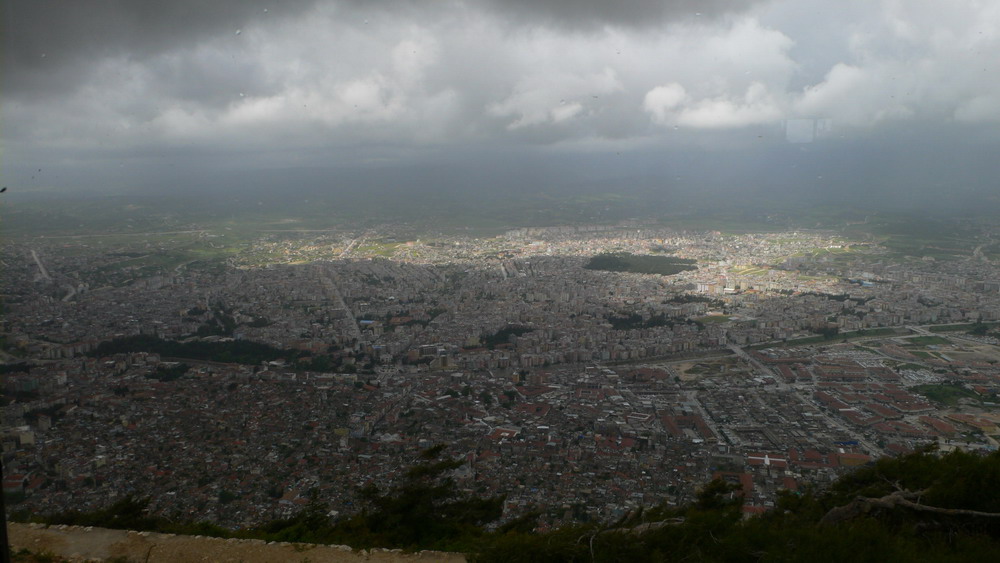
Antakya seen from the top of Mount Silpius

While the summer months in Antakya are rather dry the winter can be very wet indeed. At times you have thunderstorms lasting more than 24 hours rolling back and forth between the Amanus mountains to the west and Mount Silpius to the east. And the water comes down not in buckets but in bathtubs. It has cataclysmic proportions and the river Orontes overflows and takes along what it can find.

Yesterday one of the locals told me that in Arabic they call Antioch “Antakya ash-shakkhâkha” or Pissing Antakya, because of the rain.

When the Crusaders arrived at the walls of Antioch in 1097 they were so unlucky as to start the siege of the city shortly before the rainy season began. For four or five months they sat in the mud outside the city under the torrential cloudbursts.

In old days when the city centre was close to the present Grotto of St. Peter Antioch was often flooded by rain water coming down with the torrent Parmenius. This stream used to be called ονοπνικτες [Onopnictes], the Donkey-Drowner. Today it has been tamed by a canal in concrete.

But attempts to subdue the Donkey-Drowner are not new. Fifteen hundred years ago the Byzantine Emperor built a dam up between the two mountains of Staurin and Silpius so as to control the outflow during rainstorms. It is called the Iron Gate.

.

Parmenius today

Monday, 12 July 2010

Simeon Stylites the Older

In the fourth century monasticism was gaining popularity in Antioch. But it did not stay with that. Many started to find more austere ways to express their religiosity.[1] In Antioch most of this sort of people took shelter in some cave on the slopes of mount Silpius or elsewhere and spent their time contemplating their salvation. But in the beginning of the fifth century a new fashion was introduced.

A young man called Simeon (ca. 390 – 459) decided that he would spend his life on the top of a pillar believing that this would bring him closer to God. We are told that he at first had followed the habits of other anchorites, but as he was disturbed in his contemplations by many visitors he took refuge on the top of a pillar in the mountainous region between Antioch and Aleppo.

His first pillar was not very tall but as time went by the pillars grew taller and taller and Simeon’s fame grew accordingly. Visitors could still consult him by means of a ladder. So now he had visitors from everywhere and his influence on politics and decision-making in Antioch grew as well. We are told that he was able to influence politics there and even the Byzantine Emperor took him rather seriously.

But perhaps the fashion of sitting on a pillar was older than Simeon and not invented by him. A book called De Dea Syria (The Syrian Goddess) that has been ascribed to the pagan philosopher Lucian of Samosata (c. 125 – c. 180) describes a practice in a pagan temple in Hierapolis (Manbij in North Syria), not far from where Simeon climbed his pillar. This temple had been dedicated to the Mother Goddess and was a centre of sex rites.

According to Lucian the temple had a couple of “phalli”[2] or columns about 20 metres tall. On these there were “mannikins made of wood, with enormous pudenda [genital organs]”.[3] Lucian further describes how a man twice every year climbs the pillar the same way as people in Egypt climb palm trees and once up there he “abides on the summit of the phallus for the space of seven days.” Then visitors come to the place and names are shouted up to the man on the pillar so that he can pray in their behalf.[4]

Evidently the marriage between fashion and sex is an old one and even anchorites are slaves of fashion.


[1] Monasticism and asceticism are foreign to Christianity as it is described in the New Testament. The tendency may have originated with the Manicheans, a dualistic religious philosophy common at that time. – Wallace-Hadrill, Christian Antioch, Cambridge 1982, p. 25

[2] Plural of phallus, the erected male organ.

[3] Lucian, The Syrian Goddess, Forgotten Books 2007, p. 36. These small men with huge erected organs are still found in Turkish fields and often depicted on post cards.

[4] Lucian, pp. 43, 44

Saturday, 10 July 2010

Istanbul

In Byzantine times there was a close connection between Constantinople (now Istanbul) and Antioch. Constantinople was the capital of the Byzantine Empire, but Antioch was the base for the campaigns against the Persians. Some of the Byzantine Emperors even stayed in Antioch for periods of time.

There was also cultural exchange. Constantine the Great (d. 337 AD) who made Byzantium his capital and gave it the name Constantinopolis had pieces of art taken from Antioch to have them put up in the in the hippodrome in capital. In exchange Constantine saw to it that a new church was built in Antioch. It was shaped like an octagon and had a golden dome – not unlike the Dome on the Rock in Jerusalem.

Later the Emperor Valens (d. 378) who constructed the present aqueduct in Istanbul, had a new forum made in Antioch. It was situated in the neighbourhood of the present Grotto of St. Peter.

The Emperor Justinian (d. 565) who had the monumental church of Hagia Sophia built in Constantinople, had a dam erected on the river Parmenius in Antioch. It is still there between Mount Staurin and Mount Cassius up behind the Grotto of St. Peter. It is called the Iron Gate.

When the Crusaders continued to Antioch after being entertained by the Byzantine Emperor Alexius I Comnenus (d. 1118) they had to walk or ride on horseback if they belonged to the nobility. The journey took them more or less half a year. Today it takes you less than one hour and a half if you take a plane from the airport outside Antakya to the Atatürk Airport in Istanbul.

The difference between the two cities is colossal. Antakya is a small and quiet town with 200.000 inhabitants. Istanbul has about 15 million. And you feel it. When you are in Istanbul you realise that Byzantium is alive and kicking. You have museums and galleries. You have music festivals with jazz, blues, rick and classical music. And you even have a Bach festival. Really, you have all what you may be looking for.

İstıklâl Caddesi (the old Grand Rue de Pera) between the Taksim Square and Tünel is so crowded in the evening that you can hardly walk. Along the side streets you find cafes, taverns, restaurants and bars.

In old days there were riots due to differences in religion and politics and riots between the fractions on the hippodrome. Today the clashes are between the police and Kurdish partisans from southeast Turkey, between the police and union members and between the police and people whose issue you do not know anything about.

Istanbul is a fascinating but noisy place. After a weeks time you start to long for your eventless life back in Antakya.

Saturday, 26 June 2010

The Blue and the Green today

.

I do not know what happened from the time Roman horse racing went out of fashion until football was invented. The modern racing track at least is a very pale counterpart of its old predecessor. And so are its regular customers. In Byzantine times they were a wild bunch, but some of the modern Turkish hooligans do their best to imitate them.

In Antakya the partisans of the football teams Galatasaray, Beşiktaş and Fenerbahçe are well represented. In a small village outside Antakya we have even seen the big banner of Trabzon Spor (a football team from the black sea coast) hanging from one of the houses. But the modern Antiochian partisans are a lot more moderate than those of old.

Not so in Istanbul. There they do their best to imitate the supporters of the Blue team and the Green of old Byzantium. A friend of mine was nearly stabbed because he wore a scarf of wrong colours. One of the favoured weapons of the hooligans is the “döner bıçağı”, the shawarma knife, as big as a sword.

Another friend of mine, the Danish football-player Jess Høgh who used to play for Fenerbahçe, once told me that a small handful of Trabzon Spor supporters committed suicide because their team lost to his team. The Fenerbahçe team had to be escorted to the Trabzon Airport by the military.

Once there was a match between a Turkish club and a team from England. The riots in the streets were formidable. One of the hooligans was arrested and taken to court. The press and representatives of the consulate were there. He naturally denied everything, but was found guilty as one of the local newspapers had his lifelike picture on the front page showing him threatening a policeman. He was sentenced, but blamed it all on the interpreter.

In Antakya however football hooliganism is a laid-back affair.

Fortunately so!
.

Friday, 25 June 2010

The hippodrome


.
Those who have seen the movie Ben Hur may be able to understand that horse racing in the Roman Empire was a dangerous sport. Many though do not know that the hippodrome where Charlton Heston showed his talents for violent chariot driving was supposed to be the hippodrome of Antioch.

The race course was located on a big island in the river Orontes close to where the palace was built later on. Today there is no island anymore, but the ruins of the hippodrome are still to be seen in the area called Küçükdalyan north of the municipality building at a street (or road) called Cumhuriyet Mahallesi Yolu. This hippodrome was one of the largest in the Roman Empire so it is no wonder that it was remembered by the writer of Ben Hur.

It seems that certain sports attract hooligans. This also applied to horse racing in Roman and Byzantine times. In Constantinople and Antioch the spectators either supported the Blue team or the Green according to the colours they wore. It was not unlike the hooligans who support the football teams Galatasaray, Beşiktaş and Fenerbahçe in modern Istanbul – and their behaviour was not very different either. Back then the colours also spelled political stands as the Blue team was mostly supported by the Greek or conservative element and the Green team by the local Arameans. Later it got a religious flavour as the Orthodox and the Jews started to support the Blue team and the Monophysists the Green. But this is another story.

Upheavals and riots often started at the hippodrome and spread to the rest of Antioch where the frenzy of the rabid hooligans had a contagious effect on the rest of the Antiochians with murder, rape and arson as a result. No wonder that people in power wanted to control what happened at the race course. And when this at times turned out to be impossible, they simply closed the games down.


Ruins of the hippodrome in Antioch

.

Thursday, 17 June 2010

Libanius

.
More that fifteen hundred years before F. A. Neale wrote his book about Antioch Libanius was born into one of the wealthy families of the city. He was a pagan and when he grew up he became a teacher of rhetoric. Some of his students became even more famous than their teacher. One of them was the preacher John Chrysostom.

In his Oration XI Libanius gives a speech in praise of his hometown. This is how he described nature around Antioch:

This, now, I can say concerning my native city, that it is the fairest adornment of the land that is fairest under heaven. ...

With us, however, all things vie with one another, the land, the streams, the temperate blending of the climate. As for the land, it is level like the sea, deep and rich and soft, yielding easily to the plough, wonderfully surpassing the expectations of its farmers, at once good for sowing and good for growing, and splendidly suited to both kinds of crops, providing tall trees in all their beauty and sheaves of grain taller than trees are in other lands, and crops in abundance, with more than an abundance of beauty. ...

The rivers which run through the country, who could number them, some large, some small, some flourishing at seasons, others created by the winter, all equally useful, some flowing from the mountains, some raising in the plains, some flowing one into another, others into the lake and others still journeying to the sea? ...

And while winter provides rain to satiety for the earth, taking away the cold, the heat makes the wheat spring up and fosters it with summer breezes which save both our bodies and crops from damage from burning heat. Thus for us alone is it possible to enjoy whichever of the seasons is present and to receive the coming one with pleasure, since in all of them there is a certain temperateness and gracefulness. ...

(Translation by Glanville Downey)
.
A lot of things have changed in Antioch since Libanius wrote his oration. Modern Antakya cannot measure up it its own past. Most of the old and beautiful houses are neglected and left to decay while new and ugly concrete buildings are erected. And nature that Libanius praised so highly is all too often littered with garbage and empty plastic bags.

But if you look behind it, the beauty is still there.

Monday, 14 June 2010

Water

.


Kantra


Antioch is not situated in a desert. It never was. In fact, during the winter a lot of rain falls in this area. And the rain does not come down in buckets, it comes in bathtubs. On the slopes of Mount Silpius over our heads waterfalls appear and some streets downtown are flooded. In good old days the torrent of Parmenius overflowed the centre of the city just beside the river-bed. Attempts were made to dam up the Donkey-Drowner, as Parmenius was called, but first with the Byzantine Emperor Justinian something effective was done about the nuisance. He built a big wall between Mount Staurin and Mount Cassius (Orocassias) to arrest the unruly river when it lost its temper. The ruins of the Iron Gate are still to be seen. (Procopius: Buildings – Book 2, Chapter 10:15, 16)

In summertime however the weather is dry. A couple of thousand years ago the Roman emperors saw to it that water was brought to Antioch by means of aqueducts. One of them was built by Julius Caesar, others by Trajan and Hadrian. Most of these aqueducts have disappeared, but a section of one of them is located in the village of Döver on the mountainside beyond the waterfall of Harbiye (in Arabic called Beit ul-Mai – the Water-House). Halfway between Harbiye and Antakya is another aqueduct called Kantra and inside Antakya over the street where the torrent of Phyrminus used to run stands a monumental ruin called Memekli Köprü.

Today Antakya is smaller than it was fifteen hundred years ago. Floods still occur. Sometimes people drown. Antakya naturally has a water supply, but it is not stable. Therefore nearly all buildings have a water tank on the roof and a hydrophore in the basement. If not, you risk leaving the taps open when you go out and the seeing your flat flooded when you return.

For some reason there is always water in the pipes under the streets – if the water gushing forth to the surface is not spring water from some unknown source.


Memekli Köprü

Tuesday, 8 June 2010

Storytelling in Antioch

In his book Evenings in Antioch Neale relates how people in in Antakya 150 years ago used to come together in the evenings amusing themselves with songs and stories.

Things have changed. Now we have the television with its abundance of Turkish series. They are mostly extremely predictable and boresome, but they are popular with our Arabic neighbours.

Recently we experienced what good old days may have been like. We had a visit of Mithat Bey and his wife and during the visit Mithat Bey wanted to make a point. So he told us a story:

Prophet Moses - may the peace of God be upon him - once made a poor man rich. But as people came by they wanted to have a share of his fortune. As a result his riches soon started to evaporate. Finally they told him to go off to get them some food. So he did, but poisoned their shares. When he came back with the food they killed him first and ate the food afterwards. And so they all died.

A long and interesting story indeed and Mithat Bey assured us that it was not just a story. It really happened!

In some aspects Antioch has not changed.

Sunday, 6 June 2010

F. A. Neale on Antakya

About one and a half century ago the Englisman F. A. Neale stayed in Antakya for a period of time. This was what he wrote in his book Evenings at Antioch:

Antioch – The Queen of the East

Thoughts from modern Antakya

Nineteen hundred years ago Antakya in Turkey was one of the most important cities in the Roman Empire only surpassed by Rome in Italy and Alexandria in Egypt. Antioch, as it was called, had fora, it had impressive public buildings and temples and it had at least one hippodrome (depicted in the movie Ben Hur) and many public baths. Aqueducts supplied the city with water from the mountains around Daphne (now Harbiye) down south and on a big island in the middle of the river Orontes a palace was built for the Roman Emperor when he was visiting the city.

Nearly all of this has gone, destroyed by wars, fires, earthquakes, floods and general neglect. Modern Antakya has about 200.000 thousand inhabitants. There is a new city on the north-western side of the Orontes. On the eastern side in the old town the beautiful old buildings are left to decay. The street that used to be called the Colonnaded Street is still there. Two thousand years ago it was 27 metres wide with colonnades and shops on each side. Now it is about nine metres wide.

Antioch has also left an impression on peoples on peoples mind for other reasons. Two thousand years ago it was one of the important cities of the first Christians and later the theology of the so-called School of Antioch became famous. There are still Christians in Antioch living at peace with their Muslim and Jewish neighbours. Antakya is a model for the rest of the world of how people of various denominations can live together without strife. You have Sunni Muslims, Alewites, Baha’is, Catholics, Orthodox, Syrian Orthodox, Gregorian Armenians, Protestants, Jews and several other denominations. Still religious intolerance is seldom heard of.

Antakya has different sorts of problems, but it is still a place worth visiting and an interesting place to stay.